Regulation of grid-connected capacity of photovoltaic power station access line
According to the Interim Measures for the Management of Distributed Power Generation (Energy Development (2013) No. 1381), distributed power generation refers to the power generation facilities, which are built, installed and operated in or near the site where the user is located and mainly for self-use by the user, the excess electricity is connected to the Internet, and the balance adjustment of the distribution network system is featured, or the energy comprehensive cascade utilization multi-power supply facilities with power output. Including wind, solar, biomass, ocean, geothermal and other new energy power generation connected to the distribution network at various voltage levels, there is no clear limit on installed capacity. According to the Notice of the National Energy Administration on the Matters related to the Construction of wind power and photovoltaic power generation Projects in 2019 (Guofa Xinneng [2019] No. 49), new industrial and commercial distributed photovoltaic power generation projects requiring state subsidies shall meet the requirements of a single grid-connected installed capacity of less than 6 MW for non-household use. We support internal multipoint access to the distribution system, provided that the technical requirements for the safety of the grid operation are met.
According to the requirements in 4.3.1 of Technical Regulations of State Grid Corporation for Connecting Photovoltaic Power Stations to the Grid, the total capacity of small photovoltaic power stations should not exceed 25% of the maximum load in the power supply area of the transformer at the upper level. The relevant local implementation is based on the power industry standard "Technical Specification for Expansion of Power Consumer Business" (DL/T 1917-2018, hereinafter referred to as "Specification"), which proposes in "5.1.11 Distributed Power Supply" that distributed power supply with a power supply capacity of 400kW or less should be connected to the power grid of 380V or less. More than 400kW should be connected to the power grid of 10kV and above.
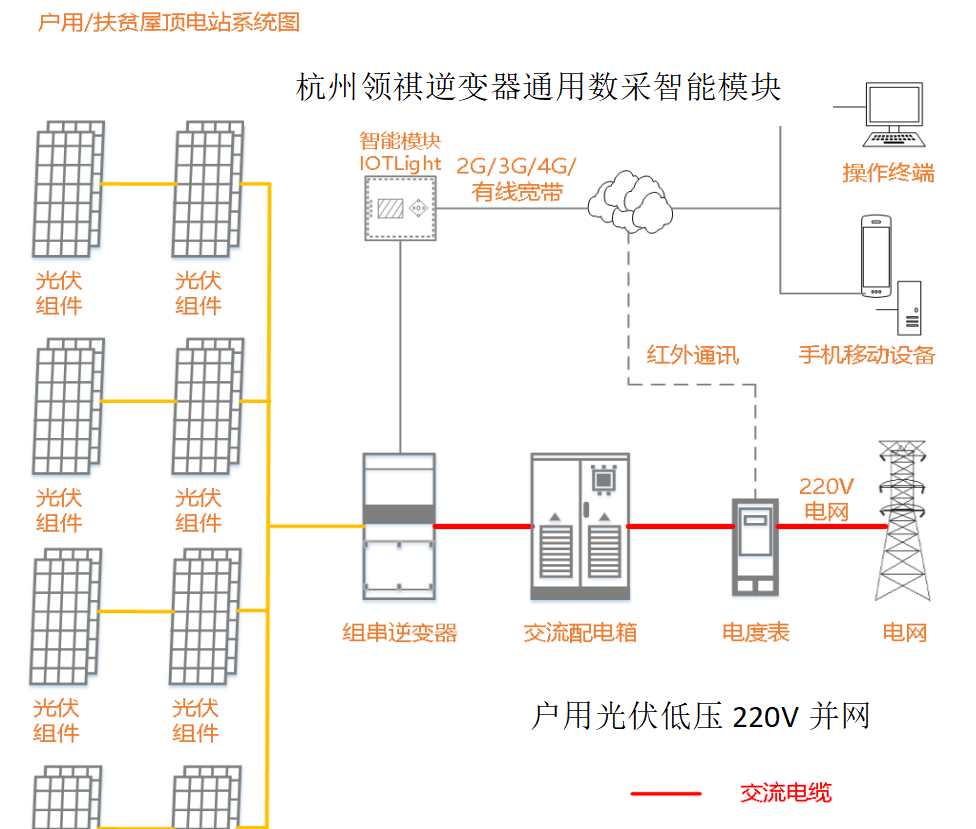
1.1 Low-voltage grid-connected scheme for photovoltaic households of Leading Qi -- acquisition inverter, degree meter, surge, anti-islanding and anti-islanding devices are placed in photovoltaic grid parallel cage
Grid-connected scheme of photovoltaic power station
Relying on the solar cell module and utilizing the electronic properties of semiconductor materials, when the sunlight irradiates on the semiconductor PN junction, a strong built-in electrostatic field is generated. Under the action of the built-in electrostatic field, light energy is converted into electric energy.
Grid-connected power generation system is divided into solar power system and wind power system. The grid-connected solar power generation system consists of photovoltaic module and photovoltaic grid-connected inverter power supply device. The photovoltaic module converts solar energy into DC electric energy, which is fed into the power grid through the grid-connected inverter photovoltaic grid-connected power generation system into AC electric energy with the same frequency and phase as the grid. Grid-connected inverter power supply is the core equipment of photovoltaic grid-connected power generation system.
Code for design of photovoltaic power generation connected to distribution network
Photovoltaic wiring mode:
The electric energy emitted by all photovoltaic panels in the photovoltaic power station is connected to photovoltaic inverter → connected to active power meter (three-phase four-wire 380v active power meter or single-phase 220v active power meter) → connected to the low-voltage side of the power distribution line and connected to the grid to complete the full grid-connected connection work of the user's photovoltaic power generation.
Technical specifications for grid-connected photovoltaic power stations
1. For rooftop distributed photovoltaic power generation projects (excluding Golden Sun Demonstration Project), electricity price subsidies shall be provided according to the total electricity quantity, with the subsidy standard being 0.2 yuan per KWH, which shall be settled by provincial power grid enterprises when they transfer to the state subsidies. For projects put into operation before October 1, 2021, the subsidy period is from October 1, 2021 to September 30, 2021; For projects completed and put into operation from October 1, 2021 to the end of 2021, subsidies will be provided for three years from the date of grid connection. The surplus on-grid electricity shall be settled by provincial power grid enterprises according to the benchmark on-grid electricity price of local coal-fired units, and shall be adjusted accordingly with the adjustment of the benchmark on-grid electricity price.
Ii. For the photovoltaic poverty alleviation power station project in Hebei Province, if it is completed and put into operation before the end of 2021, the subsidy standard will be 0.2 yuan per KWH starting from January 1, 2021, and the subsidy will be for 3 years starting from the date of grid connection. Other terrestrial photovoltaic power station projects (including distributed photovoltaic power station projects) still implement the current tariff subsidy policy for photovoltaic power stations in accordance with the document "Guiding Opinions of Hebei Provincial People's Government on Further Promoting the Healthy Development of photovoltaic Industry" (Ji Zheng [2021]83).
Capacity of photovoltaic power station connected to the power grid
The role of transformers in photovoltaic systems
There are three AC voltage levels in China. Single-phase 220V, three-phase 380V is called the low voltage, which is generally used in households and industry and commerce. Three-phase 10kV, 15kV and 35kV are called medium voltage, 110kV, 220kV, 330kV, 500kV and 1000KV are called high voltage.
State Grid Corporation stipulates: 8 kW and below can be connected to 220 V, 8 ~ 400 kW can be connected to 380 V, 400 kW ~ 6 MW can be connected to 10 kV, 5MW ~ 20 MW can be connected to 35 kV. Therefore, photovoltaic power stations below 400kW can be directly connected to the 380/220V low-voltage grid. If the power station capacity is more than 400kW into the medium voltage grid, medium power station, generally use power group series inverter and high power centralized inverter, there are many kinds of output voltage, common 315V, 400V, 480V, 500V, 540V, 690V and other kinds of, after the stage must be connected with the boost isolation transformer.
In addition to power transmission and voltage conversion, transformers also have the following functions in photovoltaic systems:
1) Electrical isolation: isolation transformer primary and secondary rely on magnetic circuit to transfer energy, components and grid electrical isolation, can prevent DC component and leakage current into the grid, suitable for negative grounding system components.
2) In the PID solution of the suppression component, the isolation transformer is connected behind the inverter, and then the potential of the N pole to the ground is increased, and the potential of the negative pole pair of the component is increased indirectly, so as to achieve the purpose of suppressing the PID of the component.
3) Matching voltage: the power grid voltage of some countries is different from our country, such as the United States is single-phase 110V, three-phase 220V, you can add a transformer behind the inverter, match the voltage of access to the country
What is the grid-connected capacity of the photovoltaic power station access line
In March 2020, the National Development and Reform Commission issued the Notice on Matters Related to the On-Grid Pricing Policy of Photovoltaic Power Generation in 2020, which further set the guiding prices for centralized photovoltaic power generation, and set the guiding prices for new centralized photovoltaic power stations in Class I to Ⅲ resource areas that are included in the scope of state financial subsidies at 0.35 yuan, 0.40 yuan and 0.49 yuan per KWH, respectively. The on-grid price of new centralized photovoltaic power stations shall be determined through market competition in principle and shall not exceed the guided price of the resource area. We will lower subsidies for distributed photovoltaic power generation for industry and commerce and lower subsidies for distributed photovoltaic power generation for household use.
Technical regulations for connecting photovoltaic power stations to the power grid
No thermal power plant is needed next to the photovoltaic power station.
All the PV module strings of the PV power station are converted from DC to AC through their respective inverters, and then collected to the low-voltage bus of the booster station. After the main transformer is boosted, the electric energy can be sent to the power grid by connecting to a substation through the outgoing line.
The photovoltaic power station itself is an independent power source and does not need support from other power plants.
The grid-connected capacity of photovoltaic power station access line is specified as
Small photovoltaic plants are only a few hundred kilowatts, and large ones can be tens of megawatts.
The small photovoltaic power generation system is composed of photovoltaic modules, series inverters, AC-DC cables and grid-connected distribution boxes, etc., and its system structure is relatively simple, generating a maximum of several hundred kilowatts. The structure of medium and large photovoltaic power stations is more complex, usually composed of photovoltaic modules, DC converters, centralized inverters, box-type transformers, high-voltage switchgear, main transformers, AC-DC cables, external high-voltage lines, etc., the capacity is generally megawatt level.
State Grid photovoltaic power station access regulations
General provisions for low voltage distribution networks
1. Low voltage distribution network, simple structure, safe and reliable. It is advisable to adopt the branch radial structure centered on the transformer or the distribution room on the column. Contact switches and fuses can be installed between the low-voltage main lines of adjacent transformers. Under normal circumstances, each transformer operates independently. In case of an accident, it will continue to supply power to the user after reverse operation.
2, low voltage distribution network, has strong adaptability, sex, the main line should be built once, the future is not enough to meet the need, can be inserted into the newly installed transformer.
3. The power supply radius of the low-voltage line should not be too large. In order to meet the requirements of the voltage quality at the end, it is generally 250m in urban areas and 150m in bustling areas.
4, in the three-phase four-wire power supply system, the neutral line section should be the same as the phase line section. In order to improve voltage quality and reduce line loss, single-phase power supply is avoided in blocks with pure lighting load.
5. The low-voltage distribution network shall implement the principle of partition power supply. The low-voltage line shall have a clear power supply range, and the low-voltage overhead line shall not cross the segment switch of the medium-voltage overhead line.
6, in order to meet the safety distance between the line and the building, reduce the external damage accidents, low voltage overhead lines, promote the use of insulated lines. The erection method can adopt cluster type or phase type. When the cluster type is used, the same transformer power supply of multiple low-voltage lines can be set up with the same pole.
Typical Design of Distributed Photovoltaic Power Generation Access System (hereinafter referred to as "Typical Design") The design scope is: the voltage level of 10kV and below is connected to the power grid, and the total installed capacity of a single connecting network is less than 6MW.
Typical Design divides 8 single-point access system schemes and 5 multi-point access system schemes according to different access voltage levels, operation modes and access points. Each typical design scheme includes the related scheme design of access system once, system relay protection and safety automatic device, system scheduling automation, system communication, measurement and settlement.
What is the approved photovoltaic capacity
Household installation of solar photovoltaic power generation system needs to go through the following procedures
I. Natural person
1. The original and copy of the ID card of the handler.
2. The original and photocopy of the property ownership certificate (or the housing use certificate issued by the township and superior government).
3. For public rooftop photovoltaic projects, the consent certificate of construction from the property, the owners' committee or all owners in the same building, as well as the use or rental agreement of the building and facilities should be provided.
4. For the contract energy management project, the contract energy management cooperation agreement signed by the project owner and the power user should also be provided.
5. In case of agency, the project owner shall also issue the Letter of Authorization for Grid-connected Business of Distributed Power Supply.
6. Copy of bank card (it should be consistent with the project investor and indicate the name of the specific network point of the opening bank)
7. Photo of user's electricity meter (meter number is clear) and panoramic photo of photovoltaic installation.
Legal persons and other organizations
1. The original ID card and photocopy of the handler, and the original power of attorney of the legal person (person in charge); Or legal person (responsible person) ID card original and copy.
2. Supporting documents of project legitimacy, such as business license, tax registration certificate, organization code certificate and land certificate.
3. Geographical location map of the power supply project (indicating the direction, adjacent roads, rivers, etc.) and relevant agreement on site rental.
4. The approval or explanation of the government investment authority approving the project to carry out the preliminary work (only applicable to the project to be approved or recorded).
After the above information is complete, go to the local power business hall for processing.
[Commitment of the State Grid] : The State Grid will provide distributed photovoltaic power generation project owners with the whole process of access system planning, energy metering device installation, grid connection acceptance and commissioning services; Support distributed photovoltaic power generation decentralized access to low-voltage distribution network, in accordance with the national policy to purchase surplus electricity; All distributed photovoltaic power generation projects are exempt from system backup capacity charges. The part of the project connected to the public power grid will also be paid by the power grid. Users only need to invest in photovoltaic power generation equipment and a small amount of cable lines and circuit breakers for their own use.
Household solar photovoltaic power grid needs to go through the procedures
At present, the power departments of each province implement the preferential policies related to the national regulations on solar power generation. The whole process of grid-connected installation, commissioning, until the acceptance and formal use of grid-connected is completely free of charge. The specific operation process of grid-connected household solar photovoltaic power generation is as follows:
1. The owner shall submit the grid-connection application to the hall of the local power grid company for the record.
2. The power grid enterprise shall accept the grid-connection application and formulate the access system plan.
3. The owner shall confirm the access system scheme and adjust the repeated application according to the actual situation.
4. The power grid company shall issue a letter of opinion for network connection.
5. The owner shall conduct project approval and project construction.
6. The owner shall apply for grid connection acceptance and commissioning after completion of construction.
7. The power grid enterprise shall accept the application for grid connection acceptance and commissioning, and install the electric energy metering device (the original meter is converted into a two-way meter).
8. Grid connection acceptance and commissioning of power grid enterprises, and signed electricity purchase and sale contracts and grid connection dispatching agreements with the owners.
9. Officially connected to the grid.
Solar photovoltaic system installation requirements
First, solar photovoltaic power generation system installation requirements: determine whether your house is suitable for the installation of residential solar energy system. To install a rooftop solar system, the roof must first be evaluated for firmness, area, and positivity. The size of the house has little effect on installation costs, but the total amount of electricity consumed by the home and the percentage of solar electricity must be determined before an accurate cost estimate can be made.
Solar panels should face west, not south: Install solar panels on your roof We are often told to face south. But the researchers found that facing Xi 'an is the best buy. The study looked at the United States, and in the United States electricity is charged on a tiered basis, which means peak electricity is more expensive, afternoon and evening peak electricity is more expensive than morning electricity, and solar power is more valuable.
If facing west, peak power would come in the afternoon, when electricity is more valuable, the researchers said.
Facing west, after 5 p.m., the panels still produce 55 percent of their peak power; If you're facing south, you're generating 15 percent of your peak power. Installing a solar tracker to keep the panel always facing the sun increases output by 45%, but the benefits are more than offset by the expensive cost of the tracker.
3. Capacity design of solar power generation system: Capacity is also the power generation power of photovoltaic power generation system, which is generally designed according to the construction roof area of residents. The installation space can be a sloping roof or a flat roof. An area of 1 square meter of flat roof can currently generate about 75W of electricity and increase the roof bearing capacity by about 35-45kg. South facing sloping roof 1 square meter can build about 130W, roof load increase about 15kg. Ordinary residents can build a 3kw to 5kw power station.
Four, the choice of solar cell modules: cell modules are divided into monocrystalline silicon cell modules, polycrystalline silicon cell modules and amorphous cell modules. Single crystal has the highest power generation efficiency, can emit more electricity under the same area, for the installation area is relatively small choose single crystal is the most appropriate, but the unit price will be higher. Polysilicon efficiency, the installation area is relatively rich choice of polysilicon more cost-effective, the price is relatively low. The lowest efficiency of amorphous silicon is generally not recommended. (Note: single crystal cells are usually rounded, polycrystalline cells are usually square)
The five major parameters of battery components are peak power, open circuit voltage, short circuit current, operating voltage and operating current. The selection of these parameters is very important. Battery modules vary in size according to power. The power of a single component ranges from 10W to 300W. The power of a single component is proportional to the area, so choose the most suitable size of battery module to meet your installation space requirements as well as the power.
Panel under sunlight (1000w/m2) : 1, in the case of no load measured voltage is open circuit voltage; 2. The current measured directly by the short circuit of the positive and negative terminals of the battery module is the short circuit current; 3. The measured voltage is the working voltage and the measured current is the working current when the load is added. The operating voltage is generally proportional to the open circuit voltage, and the operating current is proportional to the short circuit current. The selection of these four parameters is closely related to the inverter to be selected later. Generally speaking, the open circuit voltage of grid-connected battery components is generally about 40 volts, and the working voltage is generally about 30 volts. The operating current and open circuit current vary with the power of the component.
V. Selection of grid-connected solar inverter: grid-connected solar inverter, as an interface device between photovoltaic cell modules and the power grid, converts direct current energy of photovoltaic cells into AC power and transmits it to the power grid, playing a crucial role in the grid-connected photovoltaic power generation system. There are two kinds of grid-connected inverter for household use. One is centralized grid-connected photovoltaic inverter with minimum power of 1kw and input voltage ranging from 150V-550V. The other is the micro grid-connected photovoltaic inverter, which is generally used in the voltage class of AC220V, with the power from 200W to 500W, and the input voltage range is 12V ~ 28VDC. The use of the two grid-connected inverters is very different.
Warm tips:
In Northwest China, the return on investment of industrial and commercial enterprises is generally 30%-35%, and the return on investment of individual users is generally 20%-30%.
In the south, the distributed investment rate of industrial and commercial roof is about 30%, and the investment rate of individual users is generally about 20%.
Pv low voltage access capacity
50kw group series type photovoltaic inverter can be.
Based on the application scenario of distributed PV, the inverter can be matched, and the appropriate inverter can be selected according to local conditions to play the maximum role.
Depending on the conditions of the roof, such as family roof or courtyard, with small installed capacity, generally choose single-phase series inverter; when the roof area is too large, choose three-phase series inverter; industrial and commercial rooftops, complex mountain and greenhouse projects, for irregular orientation, easy to occur local occlusion, large installed capacity, and a variety of grid-connected voltages. Generally choose three-phase group series inverter.
Precautions for photovoltaic power generation
To avoid arcing and electric shock hazards, do not disconnect the electrical connection while the load is working. The plugs must be kept dry and clean to ensure that they are in good working order. Do not insert other metal objects into the connector or make any other electrical connection.
Do not touch or handle photovoltaic modules with broken glass, falling bezels, and damaged backboards unless the modules are disconnected from electrical connections and you are wearing personal protective equipment. Do not touch damp components.
Household photovoltaic maximum capacity regulation
According to Article 6.6 of the latest Design Code for Photovoltaic Power Station GB50797-2012, it is stipulated in the calculation of power generation:
1. The power generation prediction of photovoltaic power station shall be calculated and determined according to the solar energy resources of the site, and considering various factors such as the system design of photovoltaic power station, photovoltaic array layout and environmental conditions.
2. The annual average power generation Ep of photovoltaic power station is calculated as follows:
Ep=HA×PAZ×K formula:
HA -- is the total annual irradiation amount of horizontal solar energy (kW·h/m2);
Ep -- is the on-grid power generation (kW·h);
PAZ -- System installed capacity (kW);
K -- is the comprehensive efficiency coefficient.
The comprehensive efficiency coefficient K is the correction coefficient after considering the influence of various factors, including:
1) Correction coefficient of photovoltaic module type;
2) Correction coefficient of dip Angle and azimuth Angle of photovoltaic array;
3) Availability of photovoltaic power generation system;
4) Light utilization ratio;
5) Inverter efficiency;
6) Loss of collector line and booster transformer;
7) Correction coefficient of photovoltaic module surface pollution;
8) Correction coefficient of photovoltaic module conversion efficiency.
This calculation method is the most comprehensive one, but it is a test for non-senior PV practitioners to grasp the comprehensive efficiency coefficient. Generally speaking, the value of K2 is between 75% and 85%, depending on the situation.
▲ Component area -- radiation calculation method.
The on-grid electricity Ep of photovoltaic power station is calculated as follows:
Ep=HA×S×K1×K2 formula:
HA -- is the total solar radiation amount of inclined plane (kW·h/m2);
S -- total area of components (m2)
K1 -- component conversion efficiency;
K2 -- is the overall efficiency of the system.
The comprehensive efficiency coefficient K2 is the correction coefficient after considering the influence of various factors, including:
1) Power consumption, line loss and other energy reduction
The loss of AC/DC power distribution rooms and transmission lines accounts for about 3% of the total generating capacity, and the corresponding reduction correction factor is set at 97%.
2) Inverter reduction
Inverter efficiency is 95%~98%.
The efficiency of a photovoltaic cell varies with the temperature at which it is operating. As their temperature rises, the efficiency of photovoltaic modules decreases. In general, the average operating temperature loss is about 2.5%.
In addition to the above factors, other uncertain factors affecting the power generation of photovoltaic power stations include the unusable solar radiation loss, the reduction of the influence of the maximum power point tracking accuracy, and the grid absorption, and the corresponding reduction correction coefficient is 95%.
This calculation method is the variation formula of the first method, which is suitable for projects with inclination installation. As long as the irradiance of the inclined plane is obtained (or converted according to the horizontal irradiance: inclined plane irradiance = horizontal plane irradiance /cosα), more accurate data can be calculated.
▲ Standard sunshine hours -- installation capacity calculation method
The on-grid electricity Ep of photovoltaic power station is calculated as follows: Ep=H×P×K1:
P -- Indicates the installed system capacity (kW).
H -- is the local standard sunshine hours (h);
K1 -- is the comprehensive efficiency of the system (75%~85%).
This calculation method is also the change formula of the first method, simple and convenient, can calculate the daily average power generation, very practical.
▲ Empirical coefficient method
The average annual generating capacity Ep of photovoltaic power station is calculated as follows: In Ep=P×K1 formula:
P -- Indicates the installed system capacity (kW).
K1 -- is the empirical coefficient (the value varies from 0.9 to 1.8 according to the local sunshine conditions).
This calculation method is based on the actual operation experience of local photovoltaic projects, which is the fastest method to estimate the annual power generation.
Pv installed capacity
The 220V connection capacity is 8kW or less; the 380V connection capacity is 8kW to 400kW; the 220V connection capacity is 8kW or less; the 380V connection capacity is 8kW to 400 kw220 connection capacity is 8kW or less; The capacity of 380V access ranges from 8kW to 400kW. The capacity of 220V access ranges from 8kW to 400kW. The capacity of 380V access ranges from 8kW to 400kW
Photovoltaic access standard
8 kilometers. Photovoltaic power generation is a technology that directly converts light energy into electric energy by utilizing the photo-generated volt effect at the semiconductor interface. It is mainly composed of solar panels (components), controllers and inverters, and the main components are composed of electronic components. After the solar cells are packaged and protected in series, a large area of solar cell modules can be formed, and then combined with the power controller and other components to form a photovoltaic power generation device.






 0086-18958100293